How to find your face shape at home
You need a mirror (or a straight-on photo), your hair pulled back, and a soft tape measure or a ruler.
- Face length: from the middle of your hairline down to the tip of your chin.
- Forehead width: across the widest part of your forehead, about halfway between brows and hairline.
- Cheekbone width: across the cheekbones, from the outer corner of one to the other, just below the outer corners of your eyes.
- Jaw width: from the angle of the jaw below one ear to the same point on the other side.
Then compare: if the length is about 1.5 times the cheekbone width and the cheekbones are widest, you are oval. If the length is close to the width, you are round (soft jaw) or square (angular jaw). If the forehead is widest and the chin narrow, heart. If the cheekbones clearly beat both forehead and jaw, diamond. If the face is long and all three widths are similar, oblong.
Face shape chart
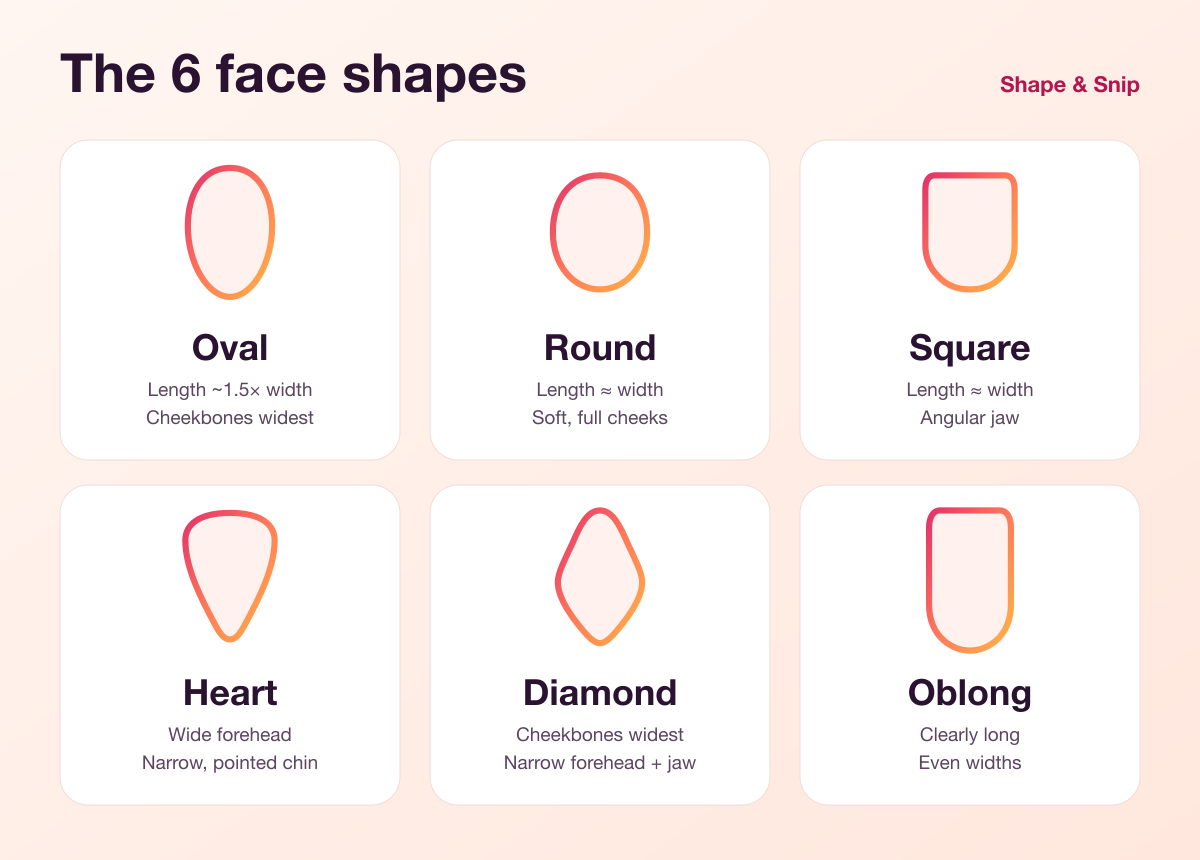
| Shape | Length vs width | Widest point | Jaw |
|---|---|---|---|
| Oval | About 1.5× | Cheekbones | Soft, narrower than forehead |
| Round | About 1× | Cheeks | Soft, rounded |
| Square | About 1× | All similar | Angular, wide |
| Heart | 1.3–1.5× | Forehead | Narrow, pointed chin |
| Diamond | 1.3–1.5× | Cheekbones, clearly | Narrow, pointed chin |
| Oblong | Over 1.6× | All similar | Straight, can be angular |
Oval face shape
How to tell: Face about 1.5 times as long as it is wide, cheekbones the widest point, jaw a little narrower than the forehead and gently rounded.
- Length about 1.5× the width
- Cheekbones widest
- Forehead slightly wider than the jaw
- Soft, rounded chin
What flatters it: Almost every cut works. Pick by hair texture and lifestyle, and avoid heavy fringes that hide the balance.
Haircuts: see which haircuts suit a oval face, or try them on your own photo above.
Glasses: wide rectangles, walnut and soft square frames, aviators. Skip frames wider than the face and very narrow frames.
Beard: Most beard styles work: keep the cheek line clean and the length even.
Often given as examples: Beyoncé, Jessica Alba, George Clooney.
Round face shape
How to tell: Face about as long as it is wide, full cheeks, a soft jaw with no strong angles and a rounded chin.
- Length close to the width
- Cheeks the widest point
- Soft, rounded jaw
- Short chin
What flatters it: Add length and angles: height on top, length below the chin, side parts and layers that start under the cheekbones.
Haircuts: the best hairstyles for round faces, or try them on your own photo above.
Glasses: rectangular and square frames, angular cat-eye, wayfarer shapes. Skip small round frames and rimless round lenses.
Beard: A beard that is shorter on the cheeks and longer at the chin lengthens the face: a short boxed beard or a goatee with stubble.
Often given as examples: Selena Gomez, Chrissy Teigen, Leonardo DiCaprio.
Square face shape
How to tell: Forehead, cheekbones and jaw close to the same width, with a strong, angular jawline and a flat chin.
- Forehead, cheeks and jaw similar widths
- Angular jaw corners
- Length close to the width
- Wide, flat chin
What flatters it: Soften the corners: layers, waves, side-swept or curtain bangs and length past the jaw. Men can lean into the angles.
Haircuts: see which haircuts suit a square face, or try them on your own photo above.
Glasses: round and oval frames, thin metal frames, rimless styles. Skip boxy, heavy square frames.
Beard: A rounded beard or stubble softens a heavy jaw; keep the sides short so the face does not look wider.
Often given as examples: Olivia Wilde, Angelina Jolie, Brad Pitt.
Heart face shape
How to tell: Wide forehead and cheekbones that taper to a narrow, often pointed chin.
- Forehead the widest point
- Cheekbones wide
- Jaw narrows sharply
- Pointed or small chin
What flatters it: Balance a wide forehead with a narrow chin: side-swept or curtain bangs, and fullness at jaw level (bobs, lobs, waves).
Haircuts: see which haircuts suit a heart face, or try them on your own photo above.
Glasses: bottom-heavy frames, light rimless or thin metal, oval and round frames. Skip top-heavy browline frames and decorated temples.
Beard: A full beard or a chin strap adds width at the jaw and balances the forehead.
Often given as examples: Reese Witherspoon, Scarlett Johansson, Ryan Gosling.
Diamond face shape
How to tell: Narrow forehead and jaw with wide, high cheekbones as the clear widest point, and a pointed chin.
- Cheekbones clearly widest
- Narrow forehead
- Narrow jaw
- Pointed chin
What flatters it: Add width at the forehead and the jaw: fringes, chin-length bobs and side parts; keep volume off the cheekbones.
Haircuts: see which haircuts suit a diamond face, or try them on your own photo above.
Glasses: oval and cat-eye frames, rimless styles, browline frames. Skip narrow frames and frames wider than the cheekbones.
Beard: A beard fuller at the chin and jaw (a goatee or a full beard) widens the lower face.
Often given as examples: Zendaya, Halle Berry, Robert Pattinson.
Oblong face shape
How to tell: Face clearly longer than it is wide, with forehead, cheeks and jaw of similar width; also called rectangle or long.
- Length well over 1.5× the width
- Straight cheek line
- Similar forehead and jaw widths
- Long chin
What flatters it: Shorten and widen: bangs, chin-to-shoulder lengths, volume at the sides; avoid height on top and long one-length hair.
Haircuts: see which haircuts suit a oblong face, or try them on your own photo above.
Glasses: tall, oversized frames, round frames, decorated temples. Skip small, narrow frames.
Beard: A beard fuller on the cheeks, kept short at the chin, makes a long face look wider.
Often given as examples: Sarah Jessica Parker, Liv Tyler, Adam Driver.
Most faces are a blend
Very few faces match a textbook shape. If you are between round and oval, or square and oblong, use the advice for both: the goals rarely clash. That is why Shape & Snip shows a score for every shape and names your runner-up instead of forcing one label. Our haircut guide by face shape and the round face hairstyles page go deeper, and you can try the cuts on your own photo.
Getting an accurate read from a photo
- Hold the phone at arm's length, at eye level. Close-up selfies stretch the middle of the face and push results toward round.
- Pull your hair back from your forehead and jaw, and take off glasses if you can.
- Face a window: a hard shadow along the jaw can look like an edge.
- Neutral face, mouth closed. A big smile widens the cheeks.
Face shape questions
What are the 6 face shapes?
Oval, round, square, heart, diamond and oblong (also called rectangle or long). Some guides add triangle (a jaw wider than the forehead) and inverted triangle, which behave like square and heart for haircut choices.
How do I know my face shape?
Compare four measurements: face length (hairline to chin) and the widths of your forehead, cheekbones and jaw. Which width is largest and how long the face is against its width decide the shape. Shape & Snip measures this from a selfie for free.
What is the difference between an oval and a round face?
Length. An oval face is about one and a half times as long as it is wide; a round face is close to as long as it is wide, with fuller cheeks. Both have a soft jaw.
What is the difference between a square and an oblong face?
Both have a forehead, cheeks and jaw of similar widths. A square face is about as long as it is wide, with angular jaw corners; an oblong face is clearly longer than it is wide.
Can your face shape change?
Your bone structure stays the same, but weight changes, aging and facial hair change how full the cheeks and jaw look, so your read can shift between neighbouring shapes, such as round and oval.
Why do two face shape tests give me different answers?
Most faces sit between two shapes, and camera angle, lens distance and hair over the outline tip the call. Look at the runner-up: Shape & Snip shows a score for all six shapes, so you can see when you are a blend.